
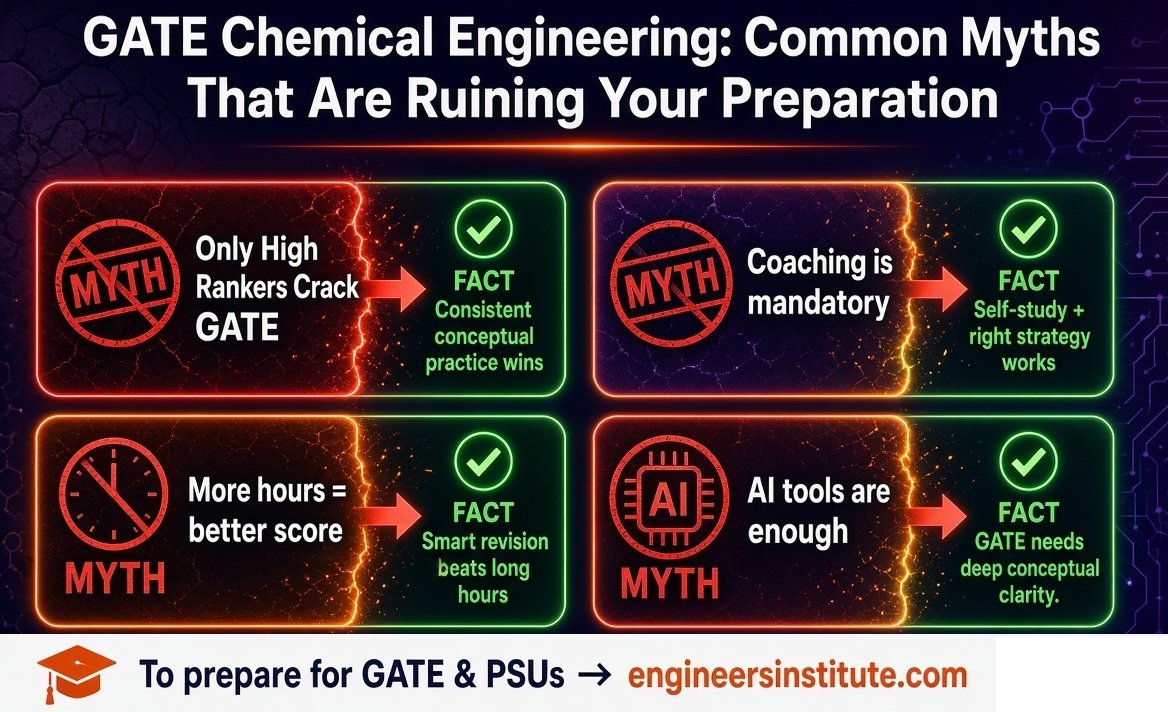
Gate chemical engineering myths look like friendly guidance, but they quietly bend your preparation away from what the exam really checks. They shape which subjects you touch first, how you judge progress and when you panic instead of adjusting with a clear head.
If you want a solid rank this year, you need a filter between loud opinions and what actually moves your marks. We will go through the common stories we hear every season, what really happens in the exam hall, which habits you can drop without guilt and how to reshape your plan without throwing away months of work.
Myth 1: Only Toppers From Big Colleges Can Crack GATE Chemical
The belief that only elite college students clear the exam is lazy and wrong. The paper checks concepts, accuracy and discipline, not your BTech college logo or past CGPA.
What usually separates selected and non selected students is boring consistency. If you keep solving standard problems, look at every mistake twice and maintain compact notes you trust, you are already ahead of many so called brand name students who keep delaying serious preparation.
Myth 2: You Must Study 12 Hours Daily From Day One
Assuming you need 12 or 14 hours every day is a quick route to burnout. For most aspirants, 4 to 6 focused hours with a written plan beat an exhausted body staring at pages for double that time.
Instead of counting hours, count finished tasks. A real study block means you picked a topic, solved a set of problems, checked solutions, marked doubts and wrote small summary points. Sitting near your books with your phone in reach does not count as study time.
Myth 3: Some Subjects Never Come So You Can Skip Them
Many students hear seniors say that some topics are low weightage and then remove whole chapters from their plan. It feels comfortable because skipping subjects makes the schedule look neat, but it raises your risk on the exam day.
Previous papers do show patterns, but the examiner is free to change those any year. A single unexpected question from a neglected chapter can cost several marks, shake your confidence and push you towards random guesses that do more damage than a calm skip.
Syllabus Weightage And Gate Chemical Engineering Myths
Most gate chemical engineering myths grow from half read weightage tables or quick comments in online groups. The syllabus is big, so your brain starts looking for permission to ignore pieces of it.
A steadier approach is to keep every subject in the plan, then reduce depth in genuinely low return zones instead of deleting them. Light coverage with formula sheets and a small set of standard questions is still safer than zero exposure to a topic.
Misreading Previous Year Question Trends
Previous papers help only if you read them with enough data. Looking at one or two years and declaring that something is not important is like checking yesterday’s weather and fixing clothes for the whole year.
So when you analyse old questions, see at least five or six years together and track concepts instead of full chapter names alone. Sometimes the same core idea hides inside very different looking questions and you catch that only when you group by concept, not book order.
Myth 4: Theory Is Enough If Your Concepts Are Clear
Conceptual clarity matters, but the exam is not a viva. It is a strict three hour test where you must convert those concepts into correct numerical answers under time pressure.
Students who only read notes and standard books usually feel confident till their first full test. Then the calculator work, unit conversions and ticking clock expose every gap they left between reading and solving, and the score falls faster than they expected.
Practice Myths In Chemical Engineering Preparation
A common part of gate chemical preparation myths busted is the idea that solving a few examples after each chapter is good practice. That is warm up, not training for a rank level attempt.
Serious practice means mixed problem sets from different chapters and repeated work on wrong questions. It also means full length tests in exam like conditions so you learn how your brain behaves in the third hour when you are tired.
Misconceptions About Test Series
Plenty of aspirants treat test series as optional or as something to start in the last two months. Then they are shocked when simple calculator slips eat marks in the real paper and there is no time left to fix that habit.
Good test series matter less for the absolute score and more for exposing patterns in your mistakes. If your score is low early on, use it to diagnose timing, concepts and guessing habits, then repeat the same papers later to see whether your fixes actually worked.
Myth 5: Only One Standard Book List Works For Everyone
Many coaching groups circulate fixed book lists as if they are sacred. Some lists are clean, some are bloated and some simply do not match how you like to learn.
Strong students rarely read every chapter from every recommended book. They usually pick one main source for each subject and add one more for weak areas, then stick to those choices instead of changing material every month when they feel bored.
How Many Sources Are Too Many
If you are making notes from three books and watching two faculty videos for the same topic, you are spreading yourself thin. Depth in one reliable source beats scattered half notes from five different places.
Before adding any new book, ask what clear gap it will fill for you. If you cannot answer that in one simple line, you probably do not need that source right now and can wait till the next revision cycle.
Myth 6: Coaching Or A Fixed Timetable Guarantees A Good Rank
Coaching helps with structure and doubt support, but it cannot sit in the exam hall for you. There are always students from big institutes who miss even a qualifying score and others from smaller towns who reach top ranks with limited guidance.
The real value from coaching appears when you go to class prepared, ask tight questions and then go home and rework the material the same day. Passive note copying in a crowded room gives you pages of content, not the habits that move your marks.
Common Misconceptions About Gate Chemical Exam Strategy
One of the louder misconceptions about gate chemical exam strategy is that someone else’s timetable will work for you exactly as it is. Toppers’ schedules look attractive, but they ignore your energy levels, backlog and current pace.
Use others’ plans as rough reference, then build your own weekly targets with honest buffers for college, travel and off days. A simple schedule that you follow for months quietly beats a glossy plan that collapses in two weeks and leaves you guilty.
Myth 7: Only Hard Questions Decide Your Rank
Many aspirants chase the toughest numerical problems they can find and feel proud after solving a few in one sitting. Then they walk into the exam and drop marks on basic questions because they never trained properly for accuracy.
Rank grows from a pile of easy and medium questions solved cleanly. Hard questions matter only after you are close to automatic on basics. If you reverse that order, you carry stress without the score to match it.
Facts Vs Myths In Question Selection
One clear part of gate chemical facts vs myths is that skipping a very hard question after one fair attempt is usually the smart choice. The paper rewards quick, clear decisions as much as raw memory.
Train yourself during mock tests to quickly label questions as sure, possible or park for later. That small habit protects your marks and keeps your head steady when the clock is running faster than you want.
Myth 8: Last Month Is The Time To Start Revision
Many aspirants keep pushing revision to after syllabus completion and never actually reach that neat finish line. The last month then becomes a messy mix of half read new chapters and forgotten old ones.
Stronger preparation brings revision in early. Even a weekly half day for revising formulas, resolving old mistakes and updating short notes is worth more than another rushed chapter stuffed right at the end.
Myth 9: English And Aptitude Do Not Need Any Preparation
General aptitude and English look easy because the level is close to school maths and daily language. So students ignore them, then lose marks on simple percentage or argument questions that were perfectly within reach.
Treat these sections as low hanging marks if your basics are normal. A small and consistent slot each week for aptitude and reading practice can protect score that lifts your rank without adding pressure on technical subjects.
Conclusion
Most habits that separate a strong attempt from a frustrating one have little to do with raw talent and a lot to do with spotting the real gate chemical engineering myths. Once you stop believing fixed stories about hours, book lists and special topics, your plan becomes calmer and honest enough to improve.
If you want a better score, start by correcting these myths in your daily routine and track your effort more than your fear. The process is not magic, and steady work has been enough for serious students at Engineers Institute for many years.
Frequently Asked Questions
Q1. Is coaching mandatory to crack GATE Chemical Engineering?
Ans. Coaching is helpful for structure and doubts, but it is not mandatory. Plenty of students clear the exam through self study using good books and test series. What matters more is consistency, honest self assessment and timely revision. If you join coaching, treat it as support, not a guarantee.
Q2. How many hours should I study daily for GATE Chemical Engineering?
Ans. Most serious aspirants do well with 4 to 6 focused hours a day, adjusted for their college or job load. Quality matters much more than raw duration. Track completed topics and practice sets instead of just counting hours on a chair. Increase hours only when you can maintain concentration and proper sleep.
Q3. Can I skip low weightage subjects in GATE Chemical Engineering?
Ans. Fully skipping a subject is risky, because exam patterns can shift and even one unexpected question can disturb your flow. A better idea is to prepare so called low weightage areas to a basic level with formulas and standard questions. That way you reduce risk without spending the same effort as core subjects. Decisions here should match your remaining time and current strengths.
Q4. When should I start giving full syllabus mock tests?
Ans. You should start full syllabus tests once most major subjects are covered at least once, usually a few months before the exam. Early mocks help you identify weak links and build stamina under a three hour timer. Do not wait to finish everything because that point rarely arrives. Use each test as feedback and repeat them after corrections.
Q5. How important are aptitude and English for GATE Chemical Engineering?
Ans. Aptitude and English carry guaranteed marks with relatively moderate effort. Many students either ignore them or study only in the final weeks, which costs easy marks. Regular short practice sessions keep you sharp here without heavy stress. Strong performance in these sections can lift your overall rank even if technical parts are average.
Q6. How early should I start preparing for the GATE Chemical Engineering exam?
Ans. Starting a year before the exam gives you enough time for concept building, practice and multiple revision cycles. If your basics are already strong, you can compress the plan into a shorter period with tighter schedules. Later starts demand more discipline and realistic topic selection. The right time is when you are ready to commit consistently, not just feel motivated for a few days.