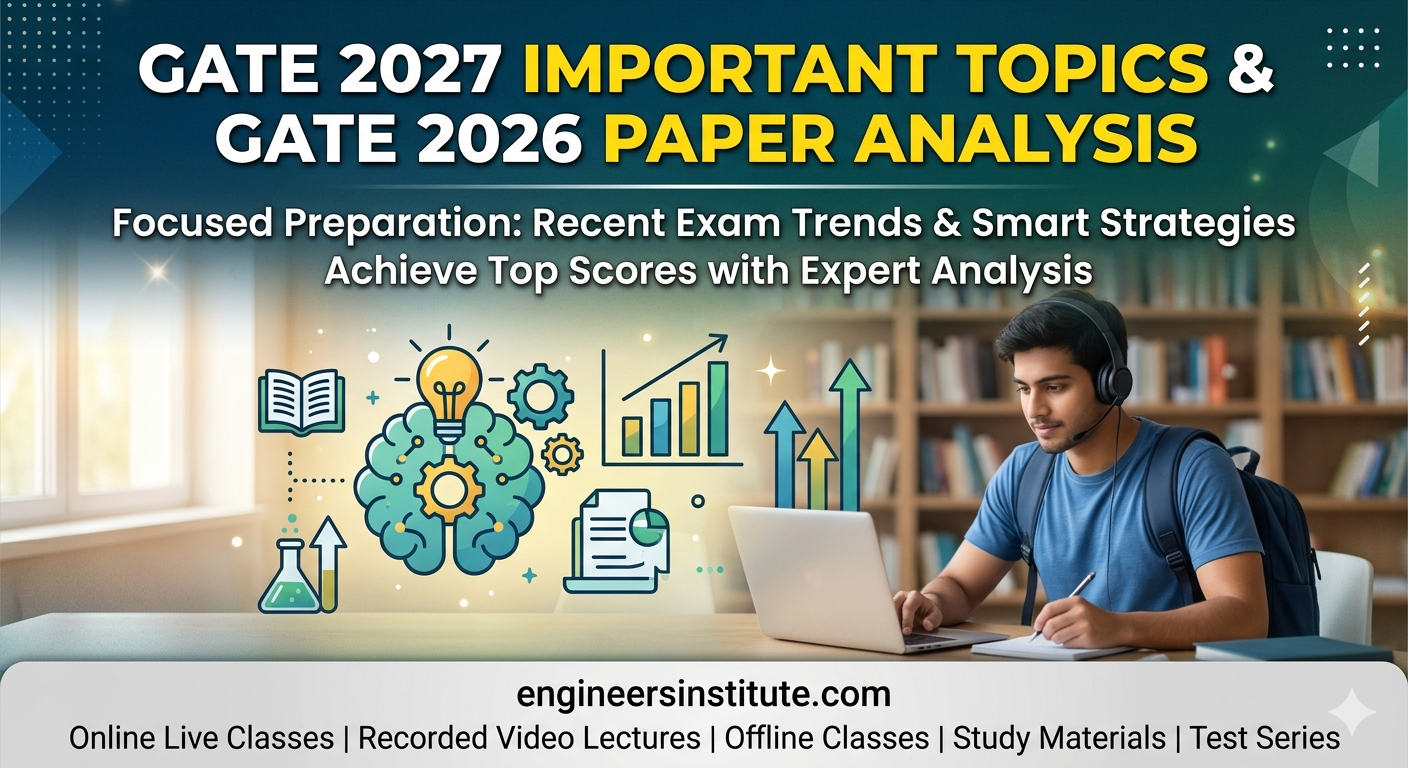
Preparing for GATE 2027 Chemical Engineering requires more than just covering the syllabus—it demands deep conceptual clarity, application-based practice, and a structured approach aligned with recent exam trends.
The GATE 2026 Chemical Enginneering paper clearly reflects a shift towards:
- Concept-driven numericals
- Multi-topic integration
- Application-based problem solving
This makes it essential for aspirants to move beyond theory and adopt smart preparation under expert guidance.
Prepare for GATE Chemical Engineering with Engineers Institute, India’s top coaching institute, offering online classes, recorded lectures, and classroom programs designed for complete concept clarity.
GATE 2026 Chemical Engineering paper Analysis – Subject-wise Concepts Asked
This is extracted directly from the paper and aligned with actual concepts tested, not just topics.
1. Thermodynamics
📌 Concepts Asked:
- Phase Rule → Degree of freedom at triple point
- Polytropic Process → Relation between P, V, n (isobaric condition)
- Heat of Reaction → Sign convention & definition
- VLE (K-Value Concept) → Bubble point pressure calculation
- Gibbs Free Energy → Equilibrium constant relation
2. Fluid Mechanics
📌 Concepts Asked:
- Bernoulli Equation → Validity conditions (inviscid, incompressible, streamline)
- Flow Regime → Laminar flow behavior
- Vena Contracta → Coefficient of contraction
- Boundary Layer Theory → Thickness variation along plate
- Velocity Profile → Average velocity derivation
3. Heat Transfer
📌 Concepts Asked:
- Kirchhoff’s Law → Emissivity = Absorptivity
- Conduction → Composite cylindrical layers
- Convection → Heat transfer coefficient usage
- Heat Exchanger → Energy balance & area calculation
4. Mass Transfer
📌 Concepts Asked:
- Equimolar Counter Diffusion → Partial pressure profile
- Absorption Design → HTU–NTU method
- Distillation → Extractive distillation concept
- VLE Relations → Equilibrium-based separation
5. Chemical Reaction Engineering
📌 Concepts Asked:
- Activation Energy → Diffusion vs reaction control
- Arrhenius Equation → Temperature sensitivity
- Parallel Reactions → Selectivity
- Batch Reactor → Volume change with conversion
6. Process Calculations
📌 Concepts Asked:
- Material Balance → Stoichiometry-based problems
- Gas Phase Reaction → Volume ratio calculation
- Conversion Calculations
- Component Balance
7. Engineering Mathematics
📌 Concepts Asked:
- Eigenvalues of Matrix
- Limits & Series Expansion
- Differential Equations
- Numerical Integration (Trapezoidal Rule)
- Probability (Conditional Probability)
8. Process Control & Instrumentation
📌 Concepts Asked:
- Inverse Response → System behavior
- Transfer Function → Zero location
- Controller Tuning → Ziegler-Nichols method
- P&ID Interpretation → Instrument function
9. Chemical Technology
📌 Concepts Asked:
- Urea Applications
- Petroleum Refining → Catalytic reforming
- Process Sequence → Kraft pulping steps
10. General Aptitude (GA)
The General Aptitude section in GATE 2026 covered a balanced mix of verbal ability, logical reasoning, and analytical skills, focusing on the following key concepts:
- Vocabulary & Sentence Understanding
Context-based word usage, synonyms, and sentence completion to test language clarity. - Visual Pattern Recognition
Identification of patterns, sequences, and logical progression in figures. - Shape Transformation & Sequence Logic
Understanding changes in shapes, rotations, and arrangement patterns. - Analytical Reasoning
Logical thinking involving conditions, distributions, and problem-solving accuracy. - Set Theory (Inclusion–Exclusion Principle)
Questions based on overlapping sets and calculation of total elements. - Paper Folding & Cube Formation
Visualization of 2D patterns into 3D structures and identifying correct configurations. - 3D Structure Matching
Spatial reasoning to match folded or rotated objects. - Direction-Based Logical Puzzles
Multi-condition reasoning involving positions like east, west, north, and south.
Important topics, concepts for GATE 2027 Chemical Engineering
If you want to be strategic for upcoming GATE preparations then focus on:
- Thermodynamics → VLE, phase rule
- Reaction Engineering → kinetics + reactors
- Mass Transfer → HTU-NTU, diffusion
- Fluid Mechanics → Bernoulli + boundary layer
- Heat Transfer → conduction + heat exchangers
To Get complete Analysis of GATE Syllabus if ChemicaL Engineering-Log on to Student’s Portal of Engineers Institute
Search thos blog article by
GATE Chemical Coaching, Online GATE Chemical Coaching, GATE 2027 Mock Test Series,
Best GATE Chemical Institute in India, Free GATE Mock Test, GATE Chemical Study Material,
Chemical Engineering Recorded Course, Offline GATE Coaching for Chemical,
GATE 2027 Preparation, GATE Chemical Online Classes, GATE Test Series with Solutions,
GATE Chemical Notes PDF, GATE Previous Year Questions Chemical,
Top Coaching for GATE Chemical Engineering, GATE Online Coaching India,
GATE Chemical Crash Course, GATE Chemical Rank Booster,
GATE 2027 Exam Preparation Strategy, Chemical Engineering Coaching Institute,
GATE Chemical Live Classes and Recorded Lectures.