
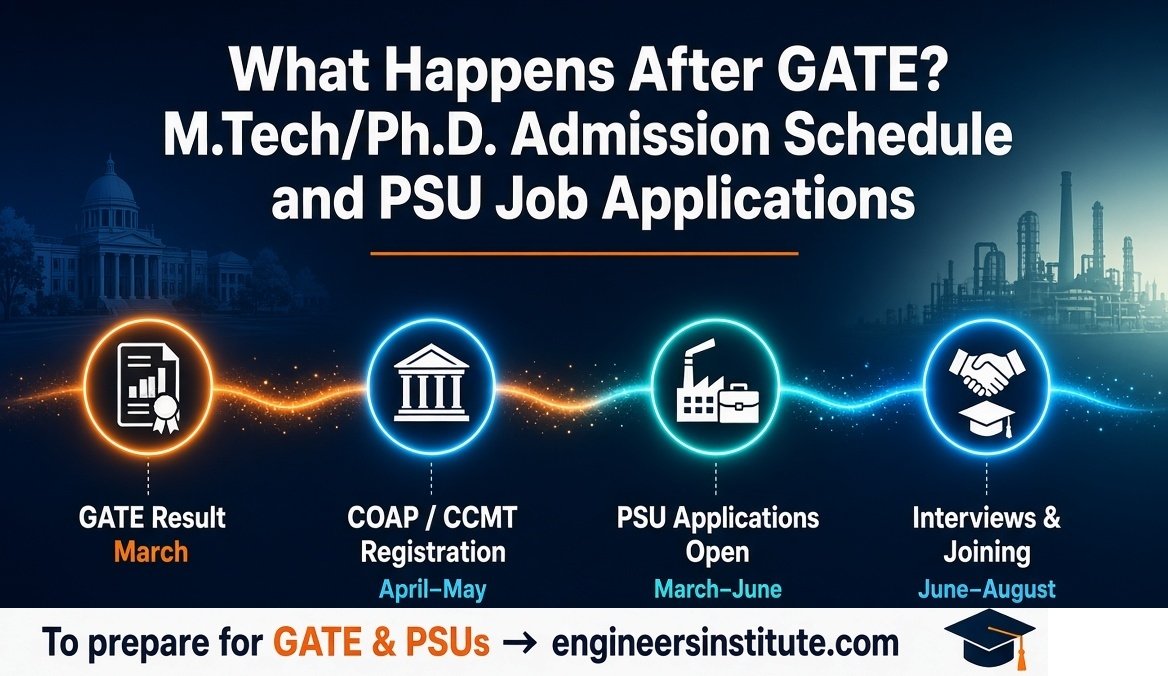
What happens after GATE exam chemical engineering is one of those questions that hits you hard as soon as the result page loads. The score alone does not change anything, what matters is how you turn that number into a seat or a job without wasting a year.
So instead of relying on chat groups and half information, it helps to see the full year laid out from result day to joining day. You will get a practical view of how the gate result to mtech admission process usually runs, where psu application after gate fits into that picture, how the gate counselling timeline overlaps with Ph.D. and job stages, and what you should decide early so you do not lose time by accident.
Reading Your GATE Result And Score Validity
The first thing after results is not rushing to fill forms, it is understanding what your score really means for chemical engineering in that specific year. A rank that looks strong on social media might be borderline once official cut offs appear, so give yourself a few days to see reliable numbers instead of trusting guesses.
Your GATE scorecard usually stays valid for more than one admission cycle for higher studies, but most PSU recruitment drives only accept the current attempt. So if public sector jobs are important for you, treat this year as the main window instead of assuming that the same score will keep all options open later.
From Result To M.Tech Admission
Many students expect the gate result to mtech admission process to run through one central portal that covers every institute. In reality, you handle a mix of common counselling for some colleges and separate forms for others, all squeezed into the few months between result day and the start of classes.
Right after results, IITs, NITs and state universities start posting application schedules, shortlisting rules and interview plans. If you care about specific campuses for chemical engineering, set up a clear calendar of their dates early, because missing one short form window can change where you study for the next two years.
CCMT And Institute Counselling Mechanics
The most structured part of a typical gate counselling timeline for M.Tech in NITs and some centrally funded institutes is CCMT. Registration usually opens a few weeks after results, then you go through rounds of choice filling, seat allotment, document checks and online or physical reporting.
CCMT is only one part of your planner though. Many IITs and several strong state universities run their own separate counselling and interviews, so you end up tracking CCMT in parallel with individual institute portals. If you miss an institute form, the GATE score by itself cannot bring you back into that pool later.
How Counselling Feels After GATE
Once counselling actually starts, the flow feels predictable even if the portals look different. You fill the form, list programmes and campuses as preferences based on score and category, then wait through allotment rounds where you decide for each offer whether to freeze it or keep sliding to a different option.
For chemical engineering, do not look only at the brand name while locking choices. Compare specialisations and typical thesis areas, look at lab facilities, and check recent placement patterns in process or core roles so you are not surprised in the final semester.
Provisional Admission And Paperwork Checks
Once you accept a counselling offer, your status usually shifts to provisional admission until verification finishes. Many students relax at this point and then discover on reporting day that a category certificate date is off, a spelling does not match or an original mark sheet is missing.
Keep academic records, identity proof, category or EWS certificates and your GATE scorecard ready in original along with several photocopies at least a week before reporting. Paperwork gaps can cost a full academic year, so treat document checks with the same seriousness as the exam itself.
Ph.D. Admissions Linked To GATE
GATE also works as an entry filter for Ph.D. admissions in many IITs, IISc and research heavy universities, especially for sponsored or direct Ph.D. paths in chemical engineering. Timelines here may overlap with M.Tech rounds or fall slightly later, depending on whether the intake is in July or in a later semester.
Most departments look at your GATE score along with B.Tech or M.Tech marks, a research proposal or statement of purpose and an interview or written test. If you are leaning towards research, keep room in your schedule for these steps instead of assuming they will fit neatly around every counselling round.
Choosing Between M.Tech And Direct Ph.D.
Plenty of chemical engineering students find themselves holding a firm M.Tech offer and one or two direct Ph.D. calls at the same time. A practical way to handle this is to secure a good M.Tech seat first as insurance, then attend Ph.D. interviews and give up coursework seats only after a clear written research offer arrives.
For a long term research career, the name on the degree matters less than the guide, the research group around you and the kind of projects and conferences you work with during those years.
PSU Application After GATE Score
psu application after gate usually follows a pattern where each organisation first announces that it will recruit through GATE, then opens its online form some time after results. For chemical engineering, not every company hires every year, so the list of PSUs and posts keeps changing from one cycle to the next.
The difficult part is that every PSU has its own portal, last date and selection stages even though almost all of them ask for your GATE registration number and score. If PSU jobs matter to you, start tracking recruitment notices early, around admit card time, so you do not miss short windows just because you were watching only the scorecard.
What Usually Happens After You Apply To PSUs
After you submit a PSU form with your GATE details, the organisation prepares an internal shortlist based on score, category and its own cut offs. If your name appears there, you are then called for further steps such as group tasks, discussions, interviews or medical checks depending on the post.
Offer letters from PSUs often arrive much later than the main M.Tech or Ph.D. joining dates. Many students quietly start a postgraduate programme and then shift only if a strong PSU offer appears, instead of sitting idle for months waiting for a result that may never come.
Handling Overlaps And Backup Plans
Across options that depend on GATE, a regular problem is that dates collide. CCMT rounds, institute interviews, Ph.D. tests and PSU stages rarely line up, so if you have not set your priorities in advance, you will feel pulled in every direction once emails start arriving.
A simple tracker helps more than most people expect. Make a table with columns for the institute or PSU name, the course or post, last date, fee date, admit card date, result date and reporting date. Once you can see all of it in one place, it becomes clearer which forms to submit, which interviews to attend and where you can step back without regret.
Even with a strong score, things do not always work the way you planned. A calm backup could be preparing for a fresh attempt, looking at solid state universities that still have chemical engineering seats or taking relevant industry work while you keep higher study options open for the next cycle.
For students sitting near cut offs, writing down a Plan B and Plan C before any rejection email arrives removes a lot of pressure. You then respond to results with decisions that you have already thought through instead of reacting in panic on the same day.
Conclusion
The real answer to what happens after GATE exam chemical engineering in India is that several admission and recruitment clocks start together and you have to choose which ones to watch closely. Once you map your result, institute forms, counselling dates, Ph.D. choices and PSU stages on a single calendar, the season stops feeling like chaos and starts looking like a series of specific decisions.
Engineers Institute can help if you treat GATE not as a single exam day but as a multi month phase where planning, steady form filling and honest backup options matter more than the raw score on the screen.
Frequently Asked Questions
Q1. How long is a GATE score valid for M.Tech admission?
Ans. A GATE scorecard is usually valid for multiple years for admission to postgraduate programmes, but institutes may have their own rules on which attempt they accept for a given cycle. Always check the specific year of score that an institute mentions in its admission brochure. For PSU jobs, most recruitment drives only accept the current year score.
Q2. Can I get a PSU job in chemical engineering with an average GATE score?
Ans. PSU recruitment in chemical engineering is competitive and cut offs can be high for general category candidates. An average score may not clear the shortlist for many PSUs, although category relaxations and variation between years mean it is still worth checking official notifications. It is sensible to keep M.Tech or other options active alongside PSU applications.
Q3. Should I wait for PSU results before joining an M.Tech programme?
Ans. Waiting without joining any programme is usually risky because PSU offer letters can come quite late or not at all. Many students join an M.Tech course and only shift if a confirmed PSU offer that they prefer arrives. This way, they do not lose an academic year.
Q4. When does CCMT counselling usually start after GATE results?
Ans. CCMT counselling for NITs and some other institutes typically begins a few weeks after GATE results are announced. The process includes registration, choice filling, seat allotment rounds and document verification. Exact dates change every year, so rely on the official CCMT website for the current schedule.
Q5. Is a direct Ph.D. after GATE better than doing an M.Tech first?
Ans. Neither route is always better, it depends on how clear you are about a research career and the offers you have in hand. Direct Ph.D. can save time for focused students who are ready for long term research work. An M.Tech first can help you explore specialisations and strengthen basics before committing to a doctoral programme.
Q6. What if I do not get any good offer in the same year as my GATE exam?
Ans. If your GATE score does not convert into the options you wanted, you can prepare to appear again, apply to institutes where admissions are still open or consider gaining industry experience for a year. The important thing is to avoid a completely idle year and to keep at least one constructive plan moving while you reassess your longer term goals.