
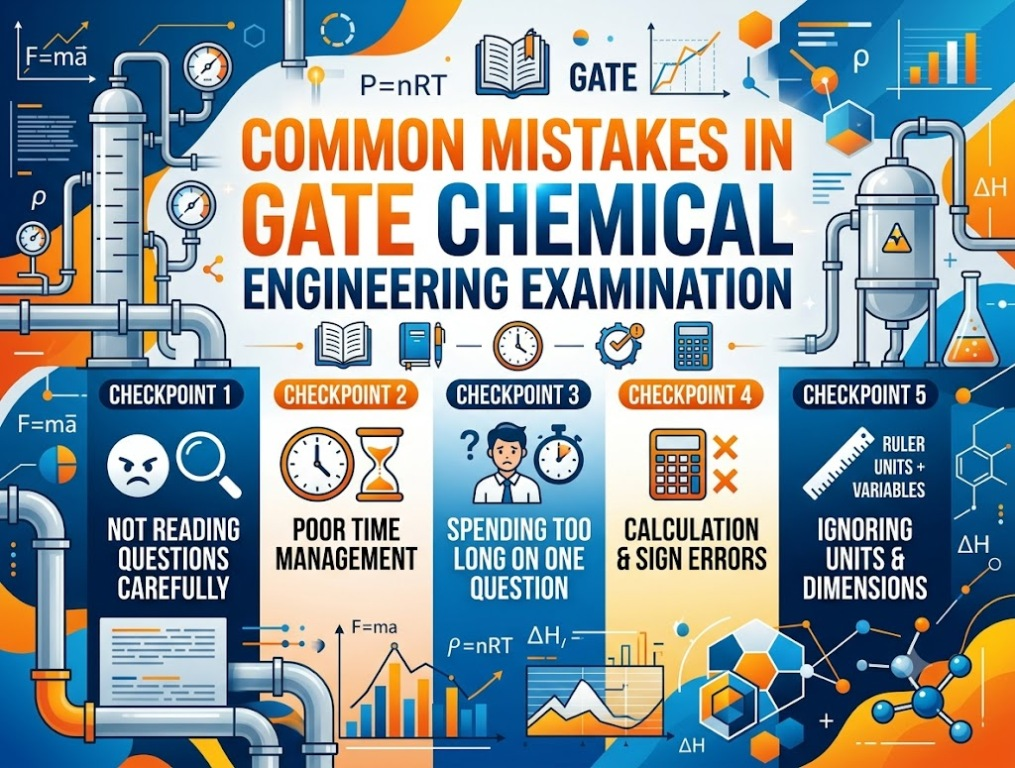
If you feel your GATE Chemical prep is “going okay” but mock scores stay stuck, you’re probably repeating the same common mistakes in GATE Chemical preparation that quietly kill a top rank. These aren’t about intelligence; they’re about approach, habits, and exam behaviour.
I’ve seen many serious aspirants across India lose an easy 15–25 marks to avoidable errors. The difference between AIR 80 and AIR 480 often isn’t extra knowledge, it’s the discipline to spot and fix these patterns early.
Ignoring Previous Years’ Papers And Real Exam Pattern
Plenty of students start with big coaching notes and thick books, but postpone previous years’ questions for “later”. That “later” never comes, and they walk into the exam without a feel for actual GATE Chemical level and weightage. This is one of the most common GATE chemical preparation mistakes to avoid.
A better approach is to anchor your plan around PYQs first and theory second. Go through at least the last 10–12 years of GATE Chemical papers topic-wise, then full paper-wise under time limits. Resources like GATE Chemical Engineering solved papers are far more valuable than adding one more reference book to your shelf.
Underestimating Numerical Practice And Units
Conceptual understanding is non-negotiable, but in the final paper your rank depends on how quickly and accurately you can convert concepts to numbers. Many aspirants revise notes multiple times but practice too few numericals per topic, especially in subjects they “like”.
That’s a big part of why students fail GATE Chemical despite covering the full syllabus once. You must treat numericals like a daily workout: mass transfer, thermodynamics, process control, fluid mechanics, and reaction engineering all demand regular problem-solving, not just weekend solving marathons.
Common Numerical Errors That Drain Marks
Most students don’t lose marks because questions are impossible; they lose them to sloppy work. Typical issues include unit conversion slips, copying data wrongly from the question, skipping intermediate writing and trying to do everything mentally, and not checking dimensional consistency once at the end.
Build a habit of pausing for 10 seconds after every calculation-heavy question to re-check units and sign. It feels slow during practice, but it trains you to avoid silly errors under pressure when each mark is precious.
Mismanaging Negative Marking And Guesswork
Another silent killer is poor risk management in the exam hall. Some students attempt almost every question in the hope that “something will click”, and end up with a mess of wrong answers. Others are so scared of negative marks that they leave even solvable questions if they aren’t 100% sure.
Both extremes are examples of GATE Chemical negative marking mistakes. GATE is a game of controlled risk: you should attempt questions where you can at least narrow down options sensibly, and skip only those where your understanding is shaky or the calculation is too long for the remaining time.
How To Build Exam Temperament For Risk Decisions
You can’t magically become good at risk-taking on exam day. Temperament is built in mock tests. Use full-length tests like the ones covered under GATE Chemical mock test & test series guides to track how many questions you get wrong because of blind guessing versus calculated attempts.
After each mock, analyse every negative-mark question and tag it: conceptual gap, silly mistake, rushing, or random guess. Your goal over time is to cut down the “random guess” and “rushing” tags sharply.
Weak Time Allocation Across Subjects
Most aspirants love some subjects and hate a few. So they keep revising favourite areas like thermodynamics or fluid mechanics, and touch mass transfer or process control once in a while “just to pass”. The result is a very unbalanced score profile that caps your total marks.
GATE Chemical isn’t cleared by scoring 90% in one subject and 20% in three others. You need a stable base across all major areas, including engineering mathematics and general aptitude. A time-table that ignores weak zones gives a false sense of progress and directly contributes to common mistakes in GATE Chemical preparation.
Using Toppers’ Strategies The Right Way
Reading topper strategies can help, but copying their schedule blindly usually fails. Their strengths, coaching background and starting level are different from yours. Use resources like the AIR under 100 in GATE Chemical blueprint as a framework, then customise it to your own weak and strong subjects.
A simple rule: every week must include time for your weakest two subjects, even if that means touching your favourite ones a little less often for a while.
Poor Revision Strategy And Last-Month Panic
Many aspirants keep collecting new material right till December or January: new hand-written notes, new test series, new books. By the time the exam is near, their table is full, but their memory is patchy. They try to revise everything in one final rush and end up revising nothing properly.
An effective plan is to freeze your core resources early, then schedule multiple revision cycles. Use short, focussed notes and formula sheets that you rebuild from your own practice. Articles on recent GATE Chemical paper analysis can guide which topics deserve more intense revision based on recent trends.
Ignoring Aptitude, Maths And Exam-Day Strategy
Too many Chemical Engineering aspirants in India still treat aptitude and mathematics as “bonus” sections instead of core scoring areas. Then they’re surprised when silly errors in basic maths drag their rank down despite decent technical performance.
Your plan must include regular practice of quantitative aptitude, English comprehension, linear algebra, differential equations, and probability. Skipping these areas is one of the most damaging gate chemical preparation mistakes to avoid, especially because they often contain relatively direct questions.
Mock Tests, Analysis And Strategy Refinement
Taking mock tests without analysing them deeply is just ego massage. After every full-length test, spend more time on post-test analysis than the test itself: identify topics consuming too much time, questions you should have left, and patterns in silly mistakes.
Use structured resources such as dedicated GATE 2027 mock tests and sample papers to simulate the exact pressure of the actual exam, and refine your question selection strategy before the real day.
Not Asking Doubts And Studying In Isolation
Some students quietly pile up doubts, thinking they’ll “sort them out later”. They keep re-reading the same paragraph in mass transfer or reaction engineering without really understanding it. This kills confidence and makes them avoid questions from those topics in the exam.
You need a reliable doubt-clearing channel, whether from seniors, mentors, or structured platforms. The Ask Doubts section is an example of how you can get specific conceptual issues resolved instead of letting them block entire chapters for months.
How To Systematically Fix These Mistakes
Spotting your mistakes is step one; building systems that stop you from repeating them is where ranks are actually made. Don’t try to change ten things in one week. Instead, pick two concrete behaviours to correct each fortnight: for example, daily numericals in a weak subject and strict mock-test analysis.
If you feel lost building that structure on your own, guided programmes like focussed GATE 2027 coaching support and curated GATE 2027 sample papers can give you a tested roadmap while still leaving enough room for your personal style of study.
Conclusion
A top rank in GATE Chemical isn’t about being perfect in every chapter; it’s about avoiding the same common mistakes in GATE Chemical preparation that stop most aspirants in India from converting hard work into marks. Issues like weak numericals, poor time allocation, neglecting mocks and careless risk-taking cost far more than any single tough topic.
Engineers Institute or any other resource can only help if you pair them with honest analysis of your own habits, smart revision and disciplined exam behaviour, so start correcting one mistake at a time and give yourself a genuine shot at the rank you’re aiming for.
Frequently Asked Questions
Q1. What are the biggest reasons why students fail GATE Chemical even after coaching?
Ans: Most students don’t fail due to lack of classes, they fail because they avoid PYQs, practise too few numericals, and don’t analyse mock tests honestly. Another major factor is weak exam temperament – panic, poor question selection and random guessing under pressure.
Q2. How can I avoid negative marking mistakes in GATE Chemical?
Ans: The key is to separate calculated risk from blind guessing. During mocks, track every wrong answer and ask if you had at least eliminated options logically or just marked something. Over time, build a rule like “attempt only if I can narrow to two options” and respect it in the actual exam.
Q3. What is the right time to start solving GATE Chemical previous years’ papers?
Ans: Start topic-wise PYQs as soon as you finish the first reading of that chapter, not after finishing the entire syllabus. Once a good portion of the syllabus is covered, include full-length papers under exam conditions. This way you learn both concept application and time management in parallel.
Q4. How do I balance GATE Chemical preparation with college or job in India?
Ans: Accept that your available hours are limited and plan accordingly instead of copying full-time aspirant routines. Focus on high-yield topics, daily short study blocks, and one serious mock test on weekends. Protect those hours from distractions the way you protect a lab session or office deadline.
Q5. How should I plan revision to avoid last-month panic for GATE Chemical?
Ans: Freeze your main resources early and plan at least two or three revision cycles. In each cycle, focus on formula sheets, typical numericals, and mistakes from previous mocks rather than reading theory from scratch. This layered revision keeps concepts fresh without overwhelming you.
Q6. What are some hidden gate chemical preparation mistakes to avoid that toppers mention later?
Ans: Toppers often admit they once wasted time on too many reference books, ignored aptitude and maths initially, and delayed doubt-solving for tough topics. They also point out how irregular sleep and inconsistent study slots hurt focus, even when total study hours looked good on paper.