
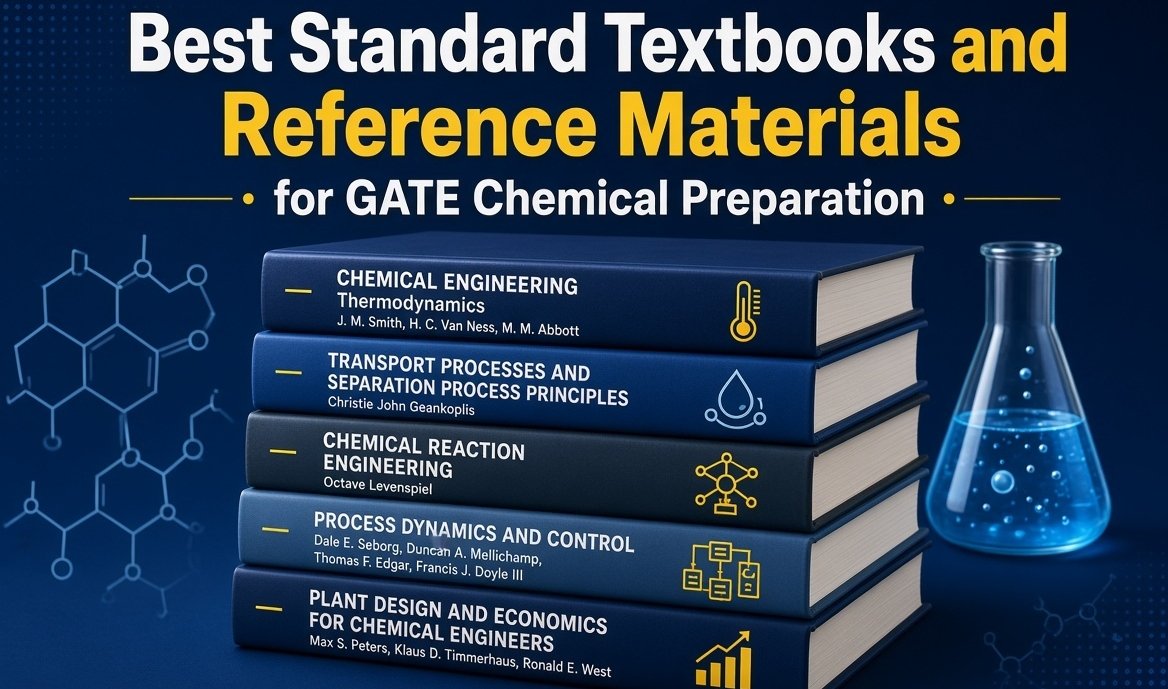
Finding the best books for GATE Chemical Engineering is harder than solving a 2-mark thermodynamics question. Seniors say one thing, Telegram groups say another, and by the time you shortlist a few, half your prep time already feels gone – especially if you are in India juggling college, coaching, or a job.
This guide fixes that. Instead of throwing 50 book names at you, we’ll focus on clear, standard textbooks and reference materials, explain how to use them smartly for GATE, and help you build a subject-wise book strategy that fits your schedule and not someone else’s.
How To Use Standard Textbooks Smartly For GATE CH
Most aspirants don’t lose marks because they picked the “wrong” book. They lose marks because they try to read every chapter like a university exam and never finish the core GATE topics. Standard books are powerful, but only if you know how deep to go.
A practical approach is a 3-layer strategy: conceptual reading from a standard text, problem practice from GATE-focused material, and quick revision notes. Your standard text should give you theory clarity and a few solved examples; your GATE material and previous year questions convert that clarity into marks.
If you’ve not yet gone through the official syllabus, pause and download the GATE 2025 syllabus pdf first. Without checking which topics actually appear, even the best gate chemical engineering reference books will feel overwhelming and misdirect your time.
Core Subjects And Their Best-Use Textbooks
Think in terms of core GATE CH groups: Fluid Mechanics, Heat Transfer, Mass Transfer, Thermodynamics, Process Calculations, and Mechanical Operations. You don’t need three books per subject. One strong textbook plus previous year questions is enough for a rank-focused plan.
For example, for Fluid Mechanics and Mechanical Operations, one standard operations or unit operations text usually covers what you need, provided you selectively read GATE-relevant chapters and then solve chapter-end numericals. Avoid hopping between authors unless you are genuinely stuck on a concept.
Once you know which chapters matter more, match them with the pattern discussed in the subject-wise weightage and scoring topics guide. That way, you’re not giving a low-weightage topic the same book-time as a high-weightage one.
Subject-Wise Book Strategy For Key GATE Chemical Topics
A good gate chemical book list subject wise doesn’t just mention titles; it tells you how to use them. Here’s a practical way to approach the most tested areas without spending months stuck on theory.
Best Books For Process Calculations And Thermodynamics
For Process Calculations, pick one classical chemical process calculations text that covers unit conversions, material balances, energy balances, and vapour–liquid systems clearly. Focus on solved examples and then attempt similar GATE problems on your own without looking at the steps.
For Thermodynamics, use a standard thermodynamics for chemical engineers book. Give extra attention to property relations, phase equilibria, availability, and refrigeration cycles because these regularly appear in GATE. Don’t get lost in advanced power cycles that the exam rarely touches.
Fluid, Heat And Mass Transfer Textbook Choices
For Fluid Mechanics, one operations or fluid mechanics text with clear treatment of Bernoulli, flow through pipes, boundary layers, and pumps is enough. Solve chapter-end questions selectively in proportion to GATE weightage instead of covering every exotic case in the book.
For Heat Transfer, use a book that explains conduction, convection, radiation, heat exchangers, and boiling/condensation with examples. Mark any solved example that resembles a previous GATE pattern – these often become your quick revision set in the last month.
For Mass Transfer, one standard separation processes or mass transfer text is sufficient. Focus on distillation (McCabe-Thiele, absorption, stripping), drying, humidification, and extraction. Keep a separate formula sheet so you don’t waste time flipping pages for every tray or column question.
Reaction Engineering, Mechanical Operations And Plant Design
Chemical Reaction Engineering deserves its own focused standard text covering mole balances, ideal reactors, design equations, non-isothermal behaviour, and RTD basics. Spend more time on isothermal reactor design and multiple-choice style conceptual questions, as GATE often tests interpretation instead of raw derivations.
For Mechanical Operations, use the unit operations text you chose earlier. Concentrate on size reduction, sedimentation, filtration, centrifugation, and agitation/mixing. You rarely need to read all equipment details in depth; focus on formulas, design relations, and the reasoning behind each operation.
Plant Design and Economics is usually low to medium weightage, so you don’t need a full design manual. A concise process design or plant design chapter from your main operations text, plus summaries on cost estimation and profitability criteria, usually suffices for GATE-level questions.
Mathematics, Process Control And General Aptitude
Engineering Mathematics carries steady weightage, yet many aspirants ignore proper standard textbooks and rely only on class notes. That’s a mistake. Use a mathematical methods or engineering mathematics book that covers linear algebra, calculus, ODE/PDE basics, probability, and complex variables with solved examples similar to GATE patterns.
For Process Dynamics and Control, pick a dedicated control or process control text that explains first and second order systems, time constants, transfer functions, block diagrams, stability, and controller tuning in simple language. Pay special attention to the Laplace approach and response plots, as they directly convert to 1-2 mark questions.
For General Aptitude, you don’t need heavy reference textbooks. Practising previous GATE papers and a mix of quality sample questions works much better than reading any generic aptitude book cover-to-cover.
India-Specific Study Constraints And How To Handle Them
Students in India often prepare for GATE CH alongside college exams, internships, or PSU recruitment tests, so time is fragmented. Instead of trying to read every page of your standard texts, mark GATE-relevant topics based on the official syllabus and past paper trends, then plan weekly targets subject-wise.
If you’re starting around six to eight months before the exam, a structured plan helps a lot. You can follow a ready 6-month study plan and plug in your chosen textbooks for detailed theory, keeping one day each week only for revision and previous year questions.
Aspirants often over-buy books because seniors recommended different authors. Remember that even the best books for gate chemical engineering won’t help if you split your attention across too many. Commit to one main text per subject, then deepen using solved problems and quality mock tests.
Combining Textbooks With Coaching And Test Series
If you join specialised GATE coaching for chemical engineering, treat class notes as a bridge between heavy textbooks and the exam pattern. Use standard textbooks mainly for concepts you didn’t fully grasp in class or where you’re consistently getting questions wrong.
Once you’ve completed at least 70% of your syllabus from books and notes, start using a structured mock test platform or online test series. This exposes which subjects need another look at the reference text and which are exam-ready.
In the final two months, reduce textbook time and switch to revision notes, formula sheets, high-yield topic lists and chapter-wise previous year questions so your effort tracks actual GATE CH trends.
How To Build Your Own Subject-Wise Book List
Start with the official syllabus and create a table of subjects vs core topics. Against each topic, write the specific chapter name from your chosen standard text. This converts a vague gate chemical engineering book list subject wise into a clear execution plan.
Then go through a recent analysis of previous papers, such as the detailed GATE CH paper analysis, to see which topics repeatedly appear. Mark those topics with a star in your table and finish their textbook coverage early in your preparation.
Finally, restrict yourself to one primary reference per subject. Use coaching notes, question banks, and mock tests to fill any small gaps instead of hunting for new books every month.
Conclusion
The best books for GATE Chemical Engineering are the ones you can actually finish, revise, and connect with the exam pattern. For most subjects, one standard textbook, a clear subject-wise plan, and steady practice from past papers beat a shelf full of untouched reference books in India.
Use your chosen texts for deep concepts, test them through questions and mock tests, and refine your weak areas using focused resources from Engineers Institute. If you commit to that cycle early, your book choices will stop being a source of doubt and start becoming your biggest advantage.
Frequently Asked Questions
Q1. How many standard textbooks do I need for GATE Chemical Engineering?
Ans: For most aspirants, one primary textbook for each major subject group is enough, supported by previous year questions and class notes. Extra books usually add confusion, not marks, so focus on depth of practice instead of piling more references on your desk.
Q2. Are gate chemical engineering reference books enough without coaching?
Ans: Strong reference books plus past GATE papers can be enough if you’re disciplined and can analyse your own mistakes. Coaching mainly helps with structure, doubt resolution and regular tests, so you’ll need to create that structure yourself if you rely only on books.
Q3. How should I create a gate chemical book list subject wise for my study plan?
Ans: Start from the official syllabus and list all subjects with their key topics, then map each topic to a specific chapter in one chosen textbook. Next, tag each topic with its approximate GATE weightage so you know where to give more revision time and question practice.
Q4. Which books are best for solving numerical problems in GATE Chemical?
Ans: Use your main standard textbooks for conceptual solved examples and then shift quickly to GATE-centric question collections. Focus on problems from thermodynamics, transport, reaction engineering and process calculations, since these areas often drive your overall score.
Q5. How should GATE Chemical aspirants in India balance textbooks with mock tests?
Ans: In the early months, spend more time on textbooks and basic problem sets to build concepts, and then gradually move toward mock tests as your syllabus coverage passes the halfway mark. In the last 6–8 weeks, prioritise full-length and subject-wise tests, using books only to clarify persistent weak concepts.
Q6. Can I prepare for GATE CH in one year if I start from basic college knowledge?
Ans: Yes, one year is usually enough if you pick a clear set of textbooks, follow a structured timetable and solve GATE-level questions consistently. The key is to avoid switching materials frequently and to revise high-weightage topics multiple times before the exam.