
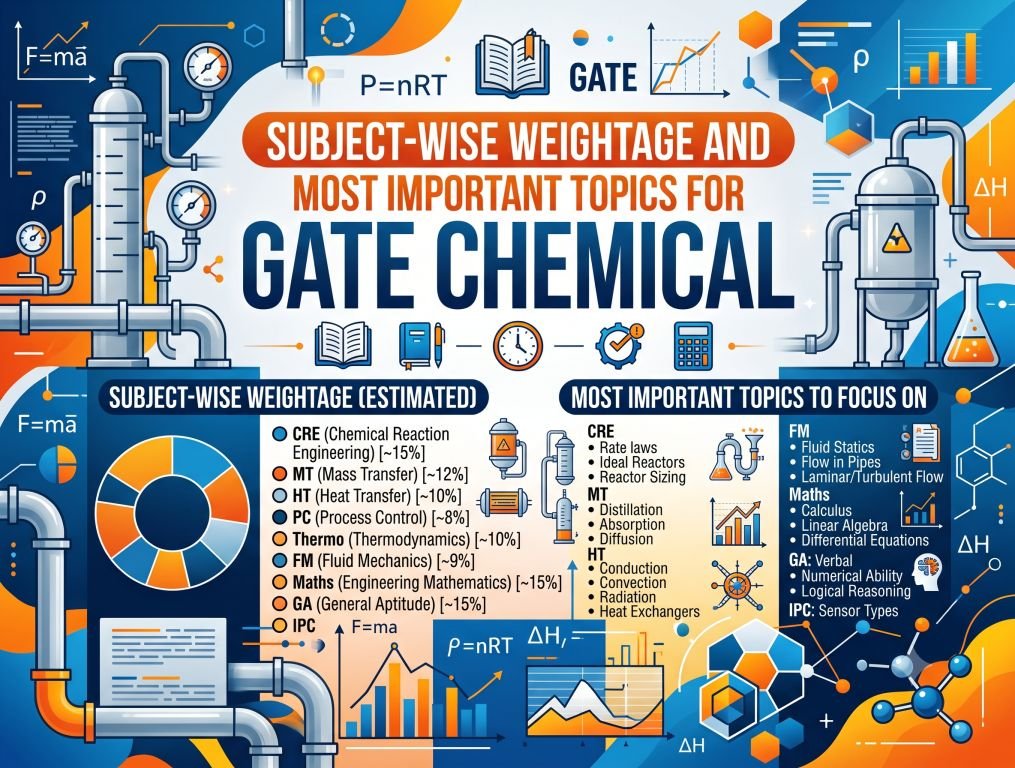
If you understand gate chemical engineering subject wise weightage clearly, your preparation becomes far more focused and less stressful. Instead of trying to “finish the whole syllabus”, you start playing to the marks distribution and push your score where it actually moves your rank.
Most aspirants in India know the broad subjects for GATE CH, but very few know which topics silently carry the highest marks, which low-weight areas can be parked for later, and how to balance theory-heavy subjects with calculation-heavy ones.
Why Subject Wise Weightage Matters So Much
The GATE CH paper is only 3 hours, but the syllabus feels endless. Subject wise weightage tells you where the examiner usually spends marks, so you can decide what deserves daily practice and what can be revised in short bursts.
From recent papers and official blueprints, three patterns stay stable: core chemical engineering subjects dominate, mathematics and aptitude together give a sizeable chunk, and a few small but tricky areas keep rotating in and out with 1–2 questions.
If you look at recent analysis of GATE chemical engineering papers, you’ll notice that ignoring weightage typically costs 10–15 easy marks, mostly because students keep over-reading low-yield chapters.
Typical GATE Chemical Marks Distribution By Subject
You’ll never get the exact same pattern every year, but some ranges are remarkably consistent. Process Calculations & Thermodynamics together generally form a strong base, followed by Fluid Mechanics, Heat Transfer and Mass Transfer as mid-to-high weightage pillars.
Then you have Chemical Reaction Engineering, Mechanical Operations and Instrumentation/Process Control, which swing between medium and high depending on the paper. Finally, there are smaller slices like Plant Design/Economics and Pollution/Environmental Engineering, which usually contribute fewer marks but are conceptually straightforward.
General Aptitude has its fixed portion, while Engineering Mathematics has its own share that often rescues students who are slightly weak in core subjects. If you’re tracking GATE 2027 updates, you’ll see that the overall balance among these areas hasn’t shifted drastically, so older trends still give a reliable direction.
High Weightage Subjects And Why They Pay Off
For most years, the unofficial “heart” of gate chemical high weightage topics is made up of four subjects: Mass Transfer, Heat Transfer, Fluid Mechanics and Chemical Reaction Engineering. These are not only heavily tested, they also connect with each other conceptually.
For example, a strong grip on dimensionless numbers and flow regimes in Fluid Mechanics makes questions on convective heat and mass transfer far more intuitive. Similarly, learning design equations in Reaction Engineering once helps you across both homogeneous and heterogeneous systems.
These subjects tend to carry plenty of numerical questions, and that’s where good practice multiplies your returns. Here, targeted practice with online mock tests and test series can quickly reveal if your concepts are clear or if you’re just copying formulae.
Most Important Scoring Topics Within Each Major Subject
Subject wise planning becomes sharper when you drill down to topic level. You don’t need equal depth everywhere; you need exam-level mastery in the chapters that keep repeating in the paper.
In Mass Transfer, distillation (McCabe–Thiele, reflux ratio, number of stages), absorption/stripping and drying often bring multiple questions. For Heat Transfer, watch conduction in plane and composite walls, heat exchangers (LMTD, NTU), and boiling/condensation basics.
Fluid Mechanics reliably asks about Bernoulli’s equation applications, flow through pipes (major/minor losses), pumps and compressors, along with basic boundary layer ideas. In Reaction Engineering, focus on ideal reactor design (CSTR, PFR, batch), non-isothermal behaviour and multiple reactions.
Once you map these as important topics for gate chemical engineering in your notes, you can plan a weekly cycle where at least one high-yield chapter appears in every single study block.
Balancing Core Subjects With Maths And Aptitude
Many students either give too much time to Engineering Maths or completely ignore it until the final months. Both extremes hurt. A balanced view of gate chemical marks distribution recognises that maths can give relatively clean, formula-based marks once you’re through the grind.
Topic-wise, Linear Algebra, Calculus, Differential Equations and Probability/Statistics tend to appear frequently. You don’t need research-level depth, but you do need speed and accuracy. One good habit is to dedicate a fixed slot every alternate day just for maths problem practice.
General Aptitude looks “easy” but still takes marks away from tired minds in the last half hour. Practising a few mixed sets regularly, along with mock tests like the ones in the GATE 2027 mock test series, keeps you sharp and stops silly mistakes in reading or basic arithmetic.
Creating A Study Plan Using Subject Wise Weightage In India
Once you understand weightage, your timetable should stop looking like a college timetable and start looking like a rank-oriented plan. A practical approach for aspirants in India is to divide each month into three layers: high-weight subjects, support subjects, and revision/testing.
High-weight subjects get more weekly hours and are always placed in your mentally fresh slots (morning or whenever you’re most alert). Support subjects such as Plant Design, Mechanical Operations or Economics can go into the lighter slots, usually post-lunch or late evening.
Every week, reserve at least one long sitting to solve previous year questions in mixed form. You can use resources like GATE chemical engineering solved papers to see how weightage actually translated into real questions.
Using Weightage To Fix Your Weekly Targets
Instead of planning by “chapters completed”, plan by “marks covered”. For example, if your analysis says Mass Transfer and Reaction Engineering together often account for a substantial share, your weekly target might be: at least 30–40 practice questions across those two, plus theory revision.
Then, add a smaller quota for low-weight but easy chapters, such as simple economic calculations or basic instrumentation. This keeps them warm without taking away deep work time from the areas that move your rank.
How Mock Tests Help You Respect Weightage
Mock tests expose a common problem: students solve their favourite topics first and leave high-weight but uncomfortable areas for the end, where time pressure kills accuracy. When you write full-length tests at regular intervals, you learn how the actual paper distribution feels.
If mock analysis shows that you routinely drop marks in one of the big subjects, that’s a clear signal to shift study hours there. Structured practice through platforms like the dedicated GATE 2027 coaching programmes can help you rebalance quickly.
Adjusting As The Exam Year Changes
Every new organising institute tweaks flavour, but the broad weightage trend hardly flips overnight. Keep an eye on the latest syllabus document and recent analysis, then adjust your emphasis slightly instead of rewriting your full strategy each year.
For example, if a particular year gives marginally more importance to Instrumentation or Environmental topics, treat it as a nudge to revise those chapters thoroughly rather than a call to ignore your main scoring areas.
Avoiding Common Traps In Weightage-Based Preparation
One of the biggest mistakes is misusing weightage as an excuse to skip uncomfortable subjects altogether. Ignoring any subject fully is risky, because even “low weightage” often means at least a couple of questions, and those might be straight formula-based ones.
Another trap is blind guesswork about subject trends without checking actual data. Rely on recent papers and structured analyses rather than rumours from random Telegram groups. If you need clarity, use doubt-solving spaces like the Ask Doubts section to get specific guidance instead of generic advice.
Finally, don’t forget that exam temperament, sleep, and stamina matter as much as subject planning. A perfect timetable means little if you’re exhausted on exam day and lose marks in topics you actually know.
Conclusion
Once you grasp gate chemical engineering subject wise weightage and map it onto your own strengths, every study hour starts working harder for you. The goal isn’t to read everything equally, it’s to secure high-yield marks while keeping weak but important areas at a safe level.
If you’re serious about a strong GATE CH rank in India, combine smart weightage analysis with disciplined practice and guided resources from Engineers Institute, and start reshaping your schedule this week rather than waiting for the “perfect time”.
Frequently Asked Questions
Q1. How is subject wise weightage decided for GATE chemical engineering?
Ans: Subject wise weightage for GATE CH comes from the official syllabus structure and the way previous years’ papers have been framed. Core areas like Mass Transfer, Heat Transfer, Fluid Mechanics and Reaction Engineering usually get more questions. Analysing the last few papers gives a practical picture of the current balance.
Q2. Which topics have the highest marks in GATE chemical engineering?
Ans: On recent trends, Mass Transfer (especially distillation and absorption), Heat Transfer (conduction and heat exchangers), Fluid Mechanics (pipe flow and pumps) and Reaction Engineering (ideal reactors and non-isothermal design) tend to be high scoring. These often form the core of gate chemical high weightage topics.
Q3. How can I use GATE CH marks distribution to plan my timetable?
Ans: Start by listing subjects in descending order of expected marks, based on past papers. Allocate more weekly hours and frequent revision to the top four or five subjects, then slot low-weight ones into lighter time blocks. Keep at least one session each week to solve mixed questions that mirror real gate chemical marks distribution.
Q4. Is it okay to skip low weightage subjects for GATE CH?
Ans: Completely skipping a subject is risky. Even low weightage areas may give simple direct questions that are quick to solve. A better approach is to study them to a basic, exam-oriented level, so you can pick up straightforward marks without investing the same depth as in high-weight subjects.
Q5. What are the most important topics for GATE chemical engineering for beginners?
Ans: If you’re starting fresh, focus first on Process Calculations, basic Thermodynamics, core Fluid Mechanics, Heat Transfer and Mass Transfer, then move into Reaction Engineering. These chapters become the backbone of your score and cover many important topics for gate chemical engineering that appear repeatedly in PYQs.
Q6. How should GATE CH aspirants in India use mock tests with subject weightage?
Ans: Take full syllabus and subject-wise tests regularly, then review which subjects and topics you miss questions in despite good weightage. Increase focused practice in those areas and reattempt similar questions. This loop helps Indian aspirants adapt their preparation to real exam patterns instead of just the theory of weightage.
9 thoughts on “Subject-Wise Weightage and Most Important Scoring Topics for GATE Chemical Engineering”