
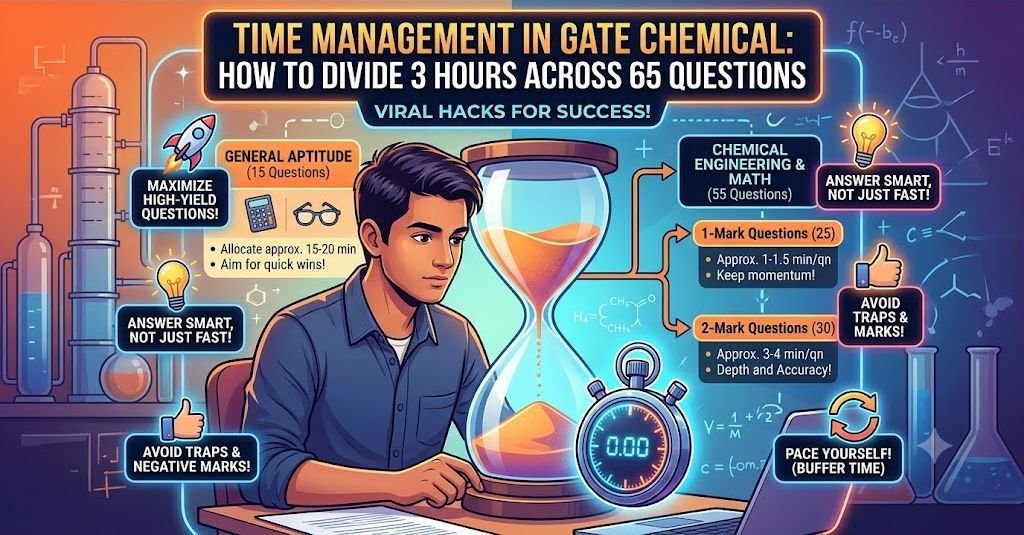
You already know the syllabus and have solved plenty of questions, but time management in GATE Chemical exam still feels like a gamble. Three hours vanish, guesses increase, and you walk out thinking, “I knew this, but I just could not manage the paper.”
If that sounds familiar, this guide will show you exactly how to divide the 3 hours across 65 questions, what to attempt first, and how to keep your mind steady under pressure in a real GATE Chemical exam hall in India.
Why Time Management Matters More Than One Extra Topic
Most GATE Chemical aspirants in India keep adding new topics till the last month and leave time strategy for “later”. That “later” never comes, and the real exam becomes the first time they think seriously about pacing. Scores suffer not because of lack of knowledge but because questions were attempted in a random order.
A clear time plan does two big things: it stops you from getting stuck on ego questions, and it makes sure you reach the easy marks at the end of the paper. Those easy questions are usually what separate a borderline score from a safe rank.
Ideal 3-Hour Macro Plan For GATE Chemical
Before going into exact minutes, remember the structure: 65 questions in 180 minutes. The paper is mixed — one mark and two mark questions, NATs and MCQs, technical and General Aptitude. A simple, workable gate chemical exam strategy 3 hours toppers often use is to split the test into three passes.
- Pass 1 (0–70 minutes): Only easy and very familiar questions.
- Pass 2 (70–150 minutes): Moderate questions and ones that need some thinking.
- Pass 3 (150–180 minutes): Marked-for-review questions, guesses, and quick checks.
This kind of structure gives you a mental map before you even see the first question, which reduces panic and keeps you from wasting time deciding “What next?” after every question.
Minute-By-Minute Breakdown Across Sections
A smart way to think about how to manage time in gate exam is to start from the score you want. If you are targeting a strong rank, you are not aiming to attempt all 65 questions. You are aiming to attempt the right 50–55 questions confidently and avoid negative marking on the rest.
Here is a practical split many serious aspirants use for GATE Chemical:
- General Aptitude (10 questions): 20–25 minutes
- Engineering Mathematics (around 10–13 questions): 30–35 minutes
- Chemical Engineering core (remaining questions): 100–110 minutes
- Buffer / Review: 15–20 minutes
You do not need to hit these numbers exactly. The idea is to avoid spending 60 minutes on the first 20 questions and then rushing through the next 45.
Smart Question Attempt Order That Actually Works
Many students underestimate how much the gate exam question attempt order affects their accuracy. Starting with a long, unfamiliar problem can drag down your confidence and speed for the rest of the paper.
Use this order, and stick to it in mocks so it becomes automatic:
- Step 1: Quick Scan (First 5 minutes)
Do a rapid scroll through the paper. Mark obvious easy questions with a clear tag in your mind. Do not solve yet; just get a sense of distribution across topics. - Step 2: General Aptitude First (Next 20–25 minutes)
GA questions are usually scoring and less time-consuming. Finishing them first gives you a psychological boost and a base score early. Skip any verbal puzzle that looks time heavy and mark it for later. - Step 3: Direct Formula Technical Questions (Next 25–30 minutes)
Pick questions where you can apply a known formula or a standard method in 2–3 steps. These are often mass transfer, heat transfer, or fluid mechanics basics you have seen many times in practice. - Step 4: NATs You Instantly Recognise (Next 20–25 minutes)
Tackle numerical answer type questions where the method is very clear to you. Avoid getting stuck re-deriving long expressions. - Step 5: Moderate And Linked Questions (Next 40–50 minutes)
Now handle questions that need a bit more algebra or multi-step reasoning. Set a hard cap: if a 2-mark problem crosses 4 minutes and you are not close to an answer, mark and move. - Step 6: Marked Questions And Guesses (Last 20–25 minutes)
Use the remaining time to revisit your marked questions in order of perceived difficulty. Do not redo everything — focus on spots where you left halfway or made a hasty assumption.
This structure keeps easy marks safe and pushes the risky questions to the last, when you already have a decent attempt count.
Time Management In GATE Chemical Exam For India-Based Aspirants
Exam centres in India can sometimes mean power cuts, delayed start, or noisy rooms. You cannot control these, but your time plan has to be strong enough to survive a 5–10 minute disturbance without collapse.
Practise your full 3-hour strategy with such small “distractions” built in: phone ringing in another room, someone talking, or a short break timer going off. When it happens in the actual centre, your brain treats it as familiar, not as a reason to panic and lose time.
Section-Wise Time Management In GATE Chemical Exam
Within the broader plan, each section needs its own rulebook. In General Aptitude, your goal is speed with accuracy — never spend more than 3 minutes on any one GA question. For Engineering Mathematics, avoid over-attachment to a favourite topic; one stubborn problem can quietly eat 8–10 minutes.
For core Chemical Engineering, prioritise topics where you are consistently strong in mocks. Hitting those first lets you bank marks early, and you go into weaker areas with less pressure on your shoulders.
How To Use The On-Screen Calculator Without Losing Time
The on-screen calculator is slow and clunky. Accept that and design your method around it. Do rough calculation estimates mentally and use the calculator only when precision really matters.
Write intermediate steps clearly on the rough sheet so you do not redo work if you mis-type once. This alone can save you 5–10 minutes across the paper.
Micro Time Rules To Avoid Getting Stuck
Set personal cut-offs before the exam and stick to them. For example: not more than 2 minutes for one-mark questions and not more than 4 minutes for two-mark questions, unless you are almost done.
When the cut-off hits, move on without negotiation. That discipline is the difference between reaching 60+ questions and getting trapped in the first 35.
How To Practise And Refine Your Time Strategy
A plan you only think about in your head will fall apart in the real exam. You need at least 8–10 full-length mock tests where your entire focus is time management, not just marks.
After every mock, analyse three things in detail: questions you solved correctly but too slowly, questions you left despite knowing the method, and questions you attempted in a hurry and got wrong. These three buckets show exactly where your minutes are leaking.
Simple Post-Mock Time Analysis Routine
Keep a small log after each mock test. Note down total attempted questions, number of guesses, and time taken for each section. Over a few weeks, you will see patterns: maybe you always overspend on Mathematics or rush through the last 30 minutes.
Adjust your next mock based on this data. Small tweaks — like starting with a different section or cutting down on re-checks — can often recover 10–15 minutes of effective time.
Common Time Management Mistakes To Avoid
One big mistake is trying to attempt all 65 questions, even when your accuracy drops. It is usually better to leave 5–10 doubtful questions untouched than to guess randomly and lose marks to negative marking.
Another mistake is solving in strict question number order. The paper is not a storybook; it is a marks paper. Skipping a tough stretch and coming back later is a smart move, not a sign of weakness.
Conclusion
Strong time management in GATE Chemical exam is less about raw speed and more about a calm, rehearsed plan that you have tested in full-length mocks in India-like conditions. Split your 3 hours into clear passes, protect the first 70–80 minutes for easy and familiar questions, and push risky attempts to the end.
Once your timing is under control, your preparation with Engineers Institute or on your own starts converting into marks far more reliably, and the exam stops feeling like a blur of guesses and regret — start building and practising your strategy with your very next mock test.
Frequently Asked Questions
Q1. How many questions should I aim to attempt in the GATE Chemical exam?
Ans: There is no fixed “correct” attempt count, but most serious aspirants aim for around 50–55 questions with high accuracy. Trying to force all 65 often leads to careless negative marks. Focus on selecting questions smartly and protecting your accuracy instead of chasing a number.
Q2. What is the best way to manage time between 1-mark and 2-mark questions?
Ans: Go through all 1-mark questions in your first pass, picking the clearly easy ones quickly. For 2-mark questions, give them priority only when the method is straightforward and the topic is your strength. This approach supports a balanced gate chemical exam strategy 3 hours without getting trapped in long problems early.
Q3. How should I decide the question attempt order in the GATE Chemical paper?
Ans: A practical gate exam question attempt order is: General Aptitude first, then direct-formula technical questions, then familiar NATs, and lastly moderate or lengthy problems. Within each group, skip anything that looks messy on first reading and mark it for a later pass.
Q4. How can I improve my speed without losing accuracy in the GATE Chemical exam?
Ans: Start timing every practice set, even short topic-wise ones, so you get used to solving under a mild clock. Review mistakes after each session and identify if they came from rushing, careless reading, or conceptual gaps. Gradual speed improvement with consistent review is safer than forcing yourself to “solve faster” overnight.
Q5. What special time management tips should students in India follow for GATE exam centres?
Ans: Expect small delays or distractions and do not let them shake your confidence or rhythm. Use the waiting time before the exam to mentally rehearse your 3-hour plan instead of discussing “out of syllabus” rumours. Once the paper starts, stick to your decided time blocks regardless of the centre environment.
Q6. How early should I start practising my time management strategy for GATE Chemical?
Ans: Begin serious time-bound practice at least a few months before the exam, not just in the final few weeks. Start with section-wise timed tests, then move to full-length mocks following your complete plan for how to manage time in gate exam. This spacing gives you enough cycles to refine what works for you.