
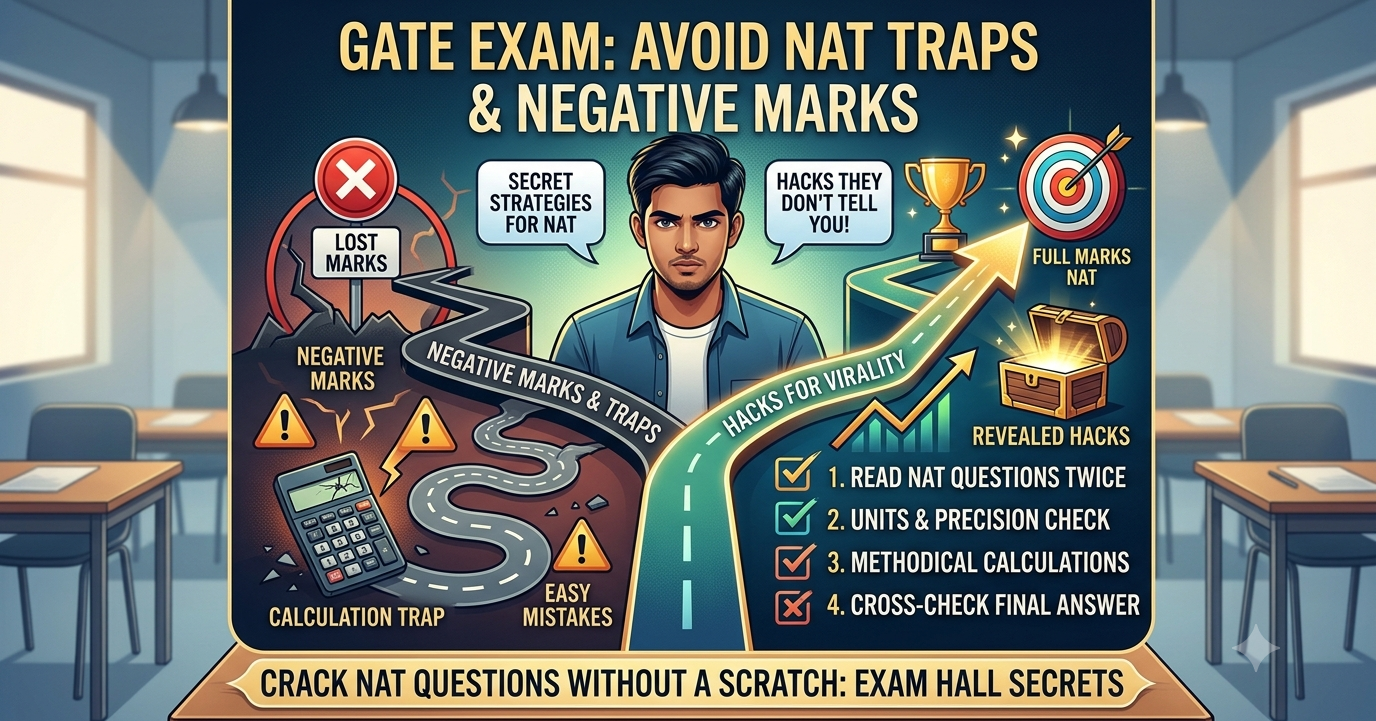
If you are tense about how to avoid negative marking in GATE NAT questions, you are not alone. Many chemical engineering aspirants in India walk out of the exam hall knowing the concept, but losing marks to a wrong digit or a careless click.
The good news is that NAT questions are predictable in how they trap you. Once you know those patterns and train a few simple habits, you can stop bleeding marks on half-solved calculations and use NATs to push your score up instead of dragging it down.
Why NAT Questions Feel Risky In GATE Chemical
NATs don’t have options to “rescue” you. If your final number is off, you get zero. That makes many students in India either fear these questions too much or over-attempt them without a clear calculation plan.
In chemical engineering, NATs often combine two or three concepts in one problem: a mass balance, a property relation and a unit conversion, for example. That is exactly where common gate calculation mistakes to avoid start creeping in under time pressure.
If you’ve already covered the core syllabus using standard texts and a proper plan, solving more NATs is usually what shifts you from “conceptually okay” to exam-ready. But only if you stop repeating the same avoidable errors.
Understand How Negative Marking Works For NATs
The first mindset shift: GATE NATs technically have no negative marking, but they still destroy your effective score if you guess blindly. Every wasted minute on a doomed NAT is a mark you could have easily picked in a MCQ elsewhere.
So treat NATs as high-precision problems. Attempt them when you have a clear line of attack, not because you feel guilty skipping a long statement. This is especially true for gate nat questions negative marking type fears, where students assume they must solve everything to get a good rank.
A simple personal rule helps: if after 60–90 seconds you still don’t have a clear algebraic expression or plan written, park the question and move ahead. Come back only if time remains.
Set Up A Clean Calculation Workspace
A big part of how to avoid negative marking in GATE NAT questions is stopping visual clutter. Most students write all over the rough sheet and then misread their own numbers.
Break your rough work into neat “blocks”: one block per question, with the question number circled clearly. Draw a line after each solution. This sounds trivial, but it saves you from copying a value from the wrong line or reusing an old intermediate result by mistake.
When you start using online mocks, consciously practise this layout. If you’re taking a structured mock platform or GATE chemical test series, treat every NAT there as a lab to refine this habit, not just a score to post on social media.
Build A Fixed Calculator And Rounding Routine
The online calculator is another major source of gate chemical numerical answer type tips that get ignored until the final month. Students keep pressing keys differently every time and then blame “silly mistakes”.
Instead, fix a personal calculator routine long before the exam. For example: always type the full expression once, check it visually, then press “=” only after a 1–second pause. Never break expressions into too many pieces unless required.
Rounding also needs a rule. If the question says “round off to two decimal places”, do not round mid-way. Carry four or five decimal places through your steps and round only once at the end. In many NATs, early rounding shifts the final answer outside the accepted range.
How To Avoid Negative Marking In GATE NAT Questions With Units
Most “I almost got it right” moments in GATE chemical come from unit issues, not concept gaps. You’ve applied the formula correctly but mixed bar with kPa or kg with g.
Before writing any equation, write all given values with units in one small list, then convert them into a consistent set of units you’re comfortable with. Only then plug into the formula. This takes 10–15 seconds and saves entire questions.
This is also where a well-structured subject-wise plan helps. While working through topics with a topic weightage view, mark chapters where unit conversions show up repeatedly—thermodynamics, fluid mechanics, process control—and create a small revision sheet just for common unit pairs.
Use A Two-Pass Strategy For NAT Questions
Trying to fully solve every NAT in the first pass is one of the biggest gate nat questions negative marking traps. You burn time early and carry stress into the rest of the paper.
Instead, apply a two-pass approach. In the first pass, solve only the short NATs or those where the algebra is straightforward. Mark the rest for review. In the second pass, tackle the heavier calculations if your brain still feels fresh.
During mock tests, consciously classify NATs into “short calculation” and “long calculation” as soon as you read them. Over a few mocks you’ll get faster at sensing which ones deserve early attention.
Spot And Skip Hidden Time Sinks
Some GATE chemical NATs are designed to tempt you into long manipulations for just one mark. A long paragraph, multiple data points, and too many symbols in the options area are clues.
If you see three or more stages of calculation—say, property estimation, followed by design equation, followed by iteration—check quickly whether the marks assigned justify that time. For a 1-mark NAT, it usually doesn’t.
Practise this judgement in mocks and past papers. Solving past questions along with sample paper style problems helps you learn that instinct before the actual exam day.
Reduce Repetition Errors With Structured Steps
Repetition errors happen when you switch between too many formulas or variables in a hurry. You repeat a step, skip a minus sign or copy the wrong coefficient. These are classic gate calculation mistakes to avoid in the pressure of the last hour.
To control this, force a three–step discipline for every NAT: write the formula, substitute values clearly, then compute. Never jump straight to substitution from memory. This extra line on the rough sheet catches missing terms before they cost you the mark.
When you analyse your mocks, mark every wrong NAT with the actual reason: concept, formula, unit or copying error. Over two or three tests, a pattern appears. Target that pattern in your next practice block.
Use Short Notes Only For Tricky NAT Patterns
Not every formula deserves a flashcard. But certain NAT patterns—like log-scale plots in reaction engineering or trick steam tables questions—do.
Keep a small “NAT traps” page in your notebook where you record only those patterns that have already cost you marks. When you revise, scan just this page before a NAT practice session.
If you’re still building your revision system, pairing this with a focused short-note approach from resources on making rapid revision notes can keep everything compact but exam-focused.
Practise NATs In Exam-Like Conditions
You can’t learn how to avoid negative marking in GATE NAT questions by casually solving one or two numericals between lectures. The exam tests how you think under a timer with an online calculator, not on a quiet notebook page.
Set strict “mini-mock” sessions: for example, 30 minutes, only NATs from a single subject, using the on-screen calculator and proper rough sheets. Track not just your score, but also how many minutes you lost on questions you eventually got wrong.
Link this habit with your broader schedule. If you’re already following a structured six–month or three–month plan using guides on long-term preparation, slot a weekly NAT-only drill so exam-style calculation becomes routine, not an occasional shock.
Train Your Mindset For The Last 30 Minutes
The final half hour of GATE can destroy a good paper if you panic over unsolved NATs. Many students in India suddenly attempt risky questions, lose accuracy and walk out with a lower rank than their preparation deserved.
Decide your last-30-minutes rules in advance: for example, no fresh long NATs in that window, only revisits and quick recalculations. If a question looks messy on a second read, let it go.
A calm, disciplined finish often adds more to your final marks than forcing one extra numerical. The exam rewards controlled aggression, not random bravery.
Conclusion
Scoring well in NATs is less about genius calculations and more about clean habits: clear units, steady calculator use, neat rough work and sensible question selection. Once you treat these as non-negotiable rules, figuring out how to avoid negative marking in GATE NAT questions becomes much simpler.
For many chemical engineering aspirants in India, a structured study plan, repeated mock practice and guidance from mentors at Engineers Institute can turn NATs from a fear zone into a scoring area. Start fixing one calculation habit this week and carry that discipline into every test you take.
Frequently Asked Questions
Q1. How can I quickly improve my accuracy in GATE NAT calculations?
Ans: Start by tagging every wrong NAT in your previous tests by reason—unit error, formula, calculator slip or concept gap. Then set up short 20–30 minute drills focusing only on that error type. Over a few sessions, you’ll see fewer repeats because you’re attacking the exact weakness, not just “practising more questions”.
Q2. What are the most common GATE calculation mistakes to avoid in chemical engineering?
Ans: The big ones are mixing units, rounding too early, missing minus signs and copying wrong data from the question. Many students also mis-handle log and exponent values on the online calculator. Force yourself to write the formula, substitute with units and only then compute; this one routine prevents a surprising number of errors.
Q3. Is it okay to leave some NAT questions unattempted to avoid negative impact?
Ans: Yes. Since NATs don’t carry formal negative marking, the real loss is time, not a direct penalty. If a question still looks messy after 60–90 seconds, mark it for review and move on. Coming back later with a clearer mind usually gives better results than forcing it during the first read.
Q4. How should I practise NATs during my GATE chemical preparation in India?
Ans: Mix topic-wise NAT practice with full-length mocks so you build both depth and exam temperament. Use previous year questions and good sample papers under a timer, with the same rough work style you’ll use in the actual exam. After each session, spend at least as much time analysing your mistakes as you spent solving.
Q5. Are there any specific gate nat questions negative marking traps I should watch out for?
Ans: Watch for long statements with unnecessary data, questions that hide a simple unit conversion and NATs that combine three or more formulas for just one mark. These are classic traps that eat time. Train yourself in mocks to spot such patterns early and decide calmly if they’re really worth attempting.
Q6. What are some gate chemical numerical answer type tips for the last week before the exam?
Ans: In the final week, stop learning new methods and focus on tightening your calculation routine. Revise a compact list of formulas, work through a handful of NATs from each major subject and re-solve only those questions where you previously made avoidable mistakes. This keeps your mind sharp on patterns that already appeared in your own practice.