
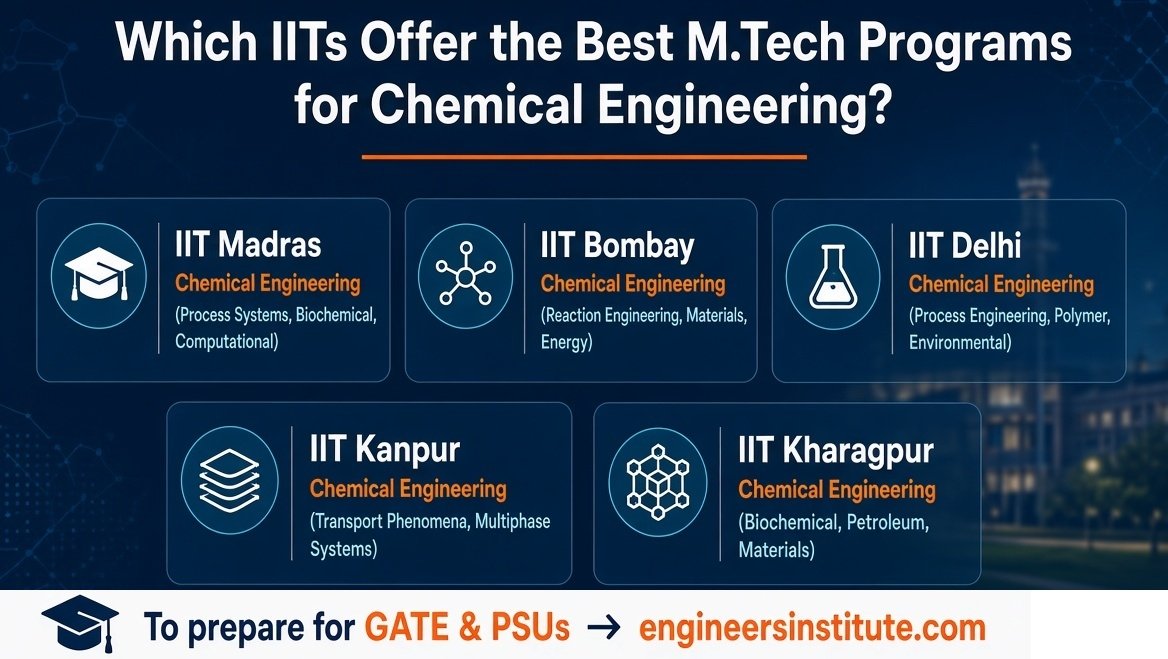
If you are searching for the best iit for mtech chemical engineering, you are probably torn between names, cut-offs, and what seniors keep telling you on WhatsApp groups. The stakes feel high because this one decision can shape your next five to ten years in India.
The problem is, every IIT sounds great on brochures. But the reality on campus is very different: course structure, research exposure, faculty attention, and placement culture all vary a lot. Let’s break it down in a practical way so you can match the right IIT to your goals instead of going only by brand or random rank lists.
How To Decide What “Best IIT” Means For You
Before shortlisting top iits for chemical engineering mtech, be clear about what you actually want from those two years. There isn’t one single “best” IIT for everyone; it depends heavily on your priority order.
Broadly, M.Tech chemical aspirants fall into three buckets: those aiming for core process industry jobs, those inclined towards research and a PhD, and those who treat M.Tech as a bridge to PSU exams or non-core careers. Your bucket decides which IIT will work better for you.
If you want high-end research, look for strong PhD output, sponsored projects and modern labs. For core jobs, placement track record and industry-linked electives matter more. If your main aim is GATE re‑attempts or PSU preparation, then lighter course load and supportive peer group help more than a fancy lab.
Top IITs For M.Tech Chemical Engineering: A Practical View
Across India, older and established IITs tend to offer deeper faculty strength and more diverse electives in chemical engineering. They usually handle bigger sponsored projects, which means more chances for you to work on live industry or funded research problems.
Newer IITs often have smaller batches and closer interaction with faculty, but the range of electives and breadth of recruiters may be limited. Many students ignore this and choose only on the basis of overall NIRF rank, which doesn’t always reflect chemical engineering strength.
While deciding for yourself, look specifically at chemical department details: faculty profiles, recent M.Tech thesis topics, and recent placement reports of the department rather than the institute overall.
Understanding IIT MTech Chemical Engineering Admission
Admission to IIT M.Tech chemical courses is primarily through GATE, followed by COAP counselling, plus occasional institute-specific written tests or interviews. The iit mtech chemical engineering admission process usually starts with a valid GATE score in Chemical Engineering (CH) or related disciplines notified by each institute.
You’ll register on COAP, fill institute forms separately, and then keep accepting, retaining, or rejecting offers every round. Many students underestimate how stressful this decision window is. If you walk into COAP without a clear priority list of IITs and specialisations, you’ll keep second‑guessing every round.
This is why having a realistic list based on your expected GATE score, category, and preference for research versus placements matters far more than gossip about “this IIT has better food” or “that city is more happening”.
What GATE Score Do You Need For Top IITs?
The first question most aspirants ask seniors is about the gate score for iit mtech chemical, but cut‑offs shift each year with paper difficulty, number of seats and applicant pool. There’s no single magic number that fits all IITs and all categories.
Instead of chasing an exact cut‑off, think in ranges. Higher-ranked IITs will naturally demand stronger GATE performance, especially for general category. Mid-ranked IITs, or specialisations with lower demand, may accept lower scores, particularly if you’re open to less popular areas like interdisciplinary energy or environmental programmes.
If you are targeting very high ranks, planning your preparation around topic-wise weightage and past-year analysis helps more than following random timetables. For that, detailed resources such as subject-wise weightage analysis for GATE chemical engineering can give you a clear idea of where each mark tends to come from.
Research vs Industry: Which IITs Suit Which Path?
Your choice of the best iit for mtech chemical engineering should separate research-focused campuses from industry-leaning ones. Some IITs push strong thesis work, publications, and PhD pipelines. Others have a more application-driven M.Tech with many electives aligned to downstream industries and refineries.
If you see yourself in a research lab or in academia, look for departments with active projects in transport phenomena, reaction engineering, CFD, or materials. Check how many recent M.Tech students have gone on to PhD programmes. On the other hand, if you want to move quickly into jobs, look at past recruiters, types of roles offered, and internship culture.
Many students planning for core jobs also keep PSU dreams alive. For them, an IIT with reasonable workload balance and a like‑minded peer group can help maintain GATE-level concepts. You can strengthen this path using structured guidance such as a 6‑month study plan for GATE chemical engineering alongside your M.Tech coursework if you decide to re‑attempt GATE.
Coursework, Electives And Lab Facilities
Once you shortlist IITs, go beyond the brochure and scan the actual course structure. Some departments stick to a heavy theory core with fewer hands‑on process modelling or design projects. Others allow you to mix electives from energy, environment, materials, or even data science.
A program that allows flexible electives helps a lot if you later tilt toward a niche like process control, polymer technology, or computational modelling. Also focus on lab infrastructure: modern equipment, simulation software licences and safety culture all affect your learning experience directly.
Faculty, Mentorship And Department Culture
Faculty strength in key chemical engineering areas—thermodynamics, separation, reaction engineering, transport, control—can tell you how wide your learning options will be. A department with just one or two faculty handling multiple core subjects may leave you with limited thesis options.
Talk to seniors or browse recent thesis titles to get a feel of whether M.Tech students get individual guidance or are treated as extra manpower on large projects. Strong mentorship often matters more for your growth than the name printed on your ID card.
How GATE Preparation Quality Affects Your IIT Options
Most students look at IITs only after the GATE result, which is quite late. In reality, the way you prepare for two years directly determines which IITs you can realistically reach for, and how much scholarship or assistantship competition you’ll face.
If your fundamentals in mass transfer, thermodynamics and process control are shaky, no IIT name can rescue the M.Tech experience. Fixing those gaps during your B.Tech and drop year is more critical than overthinking cut‑off rumours shared on Telegram groups.
You don’t have to guess your preparation strategy either. Resources like a structured GATE chemical engineering coaching roadmap or detailed guidance on best textbooks and reference books for GATE chemical can help you reach the kind of score that opens doors at multiple IITs instead of only one or two options.
Using Test Series And Past Papers Smartly
Many aspirants underestimate how sharply a disciplined test series strategy can push their GATE rank up. It isn’t just about solving a lot of papers, but taking them under exam-like timing and then spending serious time on error analysis.
If you are targeting an IIT M.Tech seat, treat at least the last few months before GATE as a mock‑exam season with a clear test plan, not random question solving. For structured practice, an organised GATE chemical mock test and test series plan can show you how close you are to the rank range usually seen in top IIT call lists.
How To Prioritise IITs During COAP
Once results are out, you’ll use COAP to accept or float offers from different IITs. This is where the real confusion starts, especially for students with multiple admits across old, new and mid-tier IITs.
To keep it simple, start from three filters: your long-term goal (industry, PSU, or research), location constraints (family, cost of living), and department strength in chemical. Rank departments, not just institutes. An older IIT with limited chemical recruiters may still be a weaker choice than a mid‑tier IIT with strong process industry connections.
Don’t rely only on social media opinions. Speak to at least a couple of current M.Tech students in the same department through college groups or alumni contacts. They’ll tell you practical things prospectus PDFs never mention, such as lab access hours, teaching assistant load, or how approachable the faculty guide actually is.
Common Mistakes Aspirants Make While Choosing IITs
Three mistakes repeat every year. First, blindly chasing the highest-ranked IIT without checking chemical department strength. Second, picking a very niche specialisation they don’t fully understand, just because the cut‑off is lower. Third, ignoring the balance between coursework load and their own health or financial situation.
Be honest about your own temperament. If you don’t enjoy long hours in wet labs, a research-heavy program can leave you frustrated. If you’re aiming for PSUs or repeated competitive exams, a more flexible timetable might help more than a department known for intense projects.
Conclusion
Choosing the best iit for mtech chemical engineering is really about matching your goals, GATE score and personal situation to the right department culture, not chasing one “top” name across India. A clear view of research strength, placements, workload and your own priorities will make COAP decisions far less stressful.
Spend most of your energy on building strong GATE fundamentals and then shortlisting IITs that genuinely fit your path; use focused guidance from Engineers Institute or similar expert mentors only to sharpen that plan, not to substitute your own thinking.
Frequently Asked Questions
Q1. Which IIT is best for M.Tech in chemical engineering for core industry jobs?
Ans: No single IIT is best for everyone. For core jobs, focus on departments where recent M.Tech chemical students are joining refineries, petrochemical plants, design firms or consulting roles. Look at department-wise placement reports and talk to seniors from that IIT before deciding.
Q2. What GATE rank is needed for IIT M.Tech chemical engineering admission?
Ans: The exact rank changes every year and by category, so treat any number you hear as a rough guideline, not a guarantee. Use previous years’ COAP trends to estimate a safe range and then target higher. A stronger rank simply gives you more IIT options across different rounds.
Q3. How should I prepare for GATE CH if I want top IITs for M.Tech?
Ans: Start with the official syllabus, standard textbooks and topic-wise previous year questions, then move to full-length mocks. Focus heavily on high‑weight subjects and frequent numerical patterns. Use a test series plus a clear revision plan in the last few months to raise both accuracy and speed.
Q4. Is M.Tech chemical engineering from an IIT worth it for PSU aspirants in India?
Ans: It can help, but it’s not mandatory. An IIT M.Tech gives you a backup in case PSU recruitment is limited and keeps you close to an academic environment while you keep your GATE concepts fresh. Just be sure you can handle M.Tech coursework along with focused PSU and exam preparation.
Q5. Can I change my specialisation within chemical engineering after joining IIT M.Tech?
Ans: Some IITs allow limited branch or specialisation changes after the first semester, subject to CGPA, seat availability and department rules. Others don’t allow it at all. Treat any possible change as a bonus, not something you depend on; try to choose a specialisation you can live with from day one.
Q6. Do I need coaching for GATE chemical to get into a good IIT?
Ans: Coaching isn’t compulsory, but structured guidance helps if you struggle with planning, discipline or conceptual clarity. A good program should give you a realistic schedule, doubt support and quality practice, while you handle self-study and revision. Many students combine smart self-study with selective coaching inputs and still make it to strong IITs.